
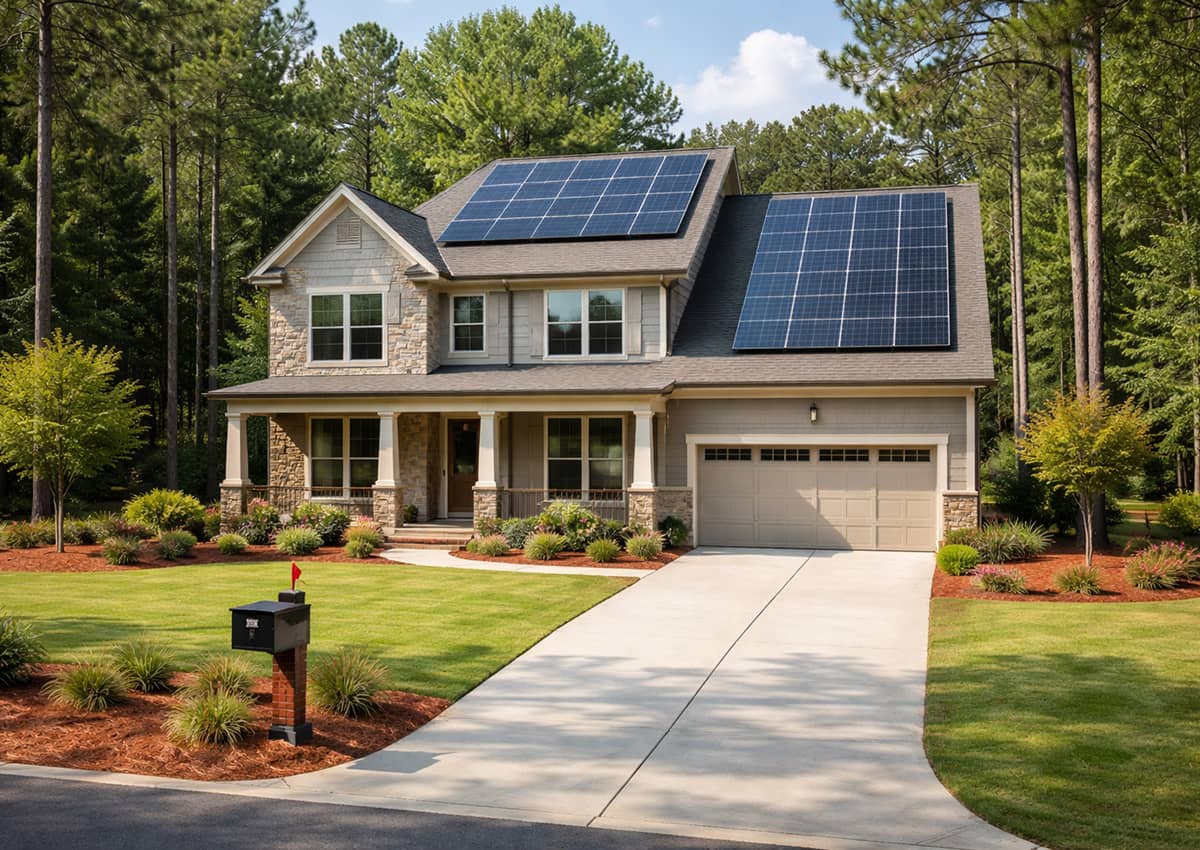
$0-Down Solar in Georgia: What "Free Panels" Actually Means
No-upfront-cost structures may be available depending on credit profile, roof condition, and utility territory.
Many Georgia homeowners search for "free solar panels" hoping to avoid large upfront costs. In practice, the word free usually describes how the project is financed — not that the equipment costs nothing.
Solar panels, inverters, permitting, and labor still carry real costs. The difference lies in how those costs are structured over time.
Check your eligibility for $0-down solar in Georgia!
Your data is safe with us.
Key Takeaways for 2026
"Free solar" typically means no upfront payment — not free hardware.
Georgia's value comes more from electricity offset and utility credit policies than from large statewide rebate programs.
Ownership and third-party agreements distribute long-term value differently.
Loan structures usually maximize lifetime control, while PPAs and leases prioritize low initial commitment.
The most important factor in Georgia solar isn't the word "free."
It's who owns the system.
Ownership determines how savings accumulate, how utility credits apply, and what happens after 20–25 years.
No-upfront-cost structures may be available depending on credit profile, roof condition, and utility territory.
How $0-Down Solar Works in Georgia
Georgia homeowners generally encounter three structures: you can pay for electricity produced (PPA), pay a fixed monthly lease, or finance ownership through a loan. All three can eliminate the installation payment at signing. They differ in who benefits from long-term production.
Georgia does not currently have a broad statewide solar rebate similar to some northeastern states. Instead, economics are shaped by:
- Utility export credit policies
- Electricity rates
- Property tax treatment
- System production
Georgia Power and other utilities do not provide free panels. What they offer are defined billing structures that may credit excess generation under specific programs and caps.
Community solar is also available in some areas for households unable to install rooftop systems.
Georgia's Three Zero-Down Structures
Instead of ranking them, let's define them clearly.
Option 1: Power Purchase Agreement (PPA)
A PPA allows a homeowner to pay only for the electricity the system produces. The solar company installs, owns, and maintains the system while billing you at a contracted energy rate.
Pros
- •Immediate bill savings if contract rate is lower than utility rate
- •No maintenance responsibility: provider handles service and monitoring
- •Predictable pricing: contracted rate provides cost certainty
Cons
- •Provider owns the system: financial mechanisms are reflected in pricing
- •Long-term contract: commitment period is typically 20-25 years
- •Rate escalation: many PPAs include annual rate increases
This approach can reduce electric bills immediately if the contract rate is lower than the utility rate. Because the provider owns the equipment, financial mechanisms are reflected in pricing rather than directly retained by the homeowner. Long-term contracts and rate adjustment terms should be reviewed carefully before signing.
Option 2: Solar Lease
A lease structure involves paying a fixed monthly amount to use the solar system. The installer remains the system owner and typically handles service and monitoring responsibilities.
Pros
- •$0 upfront cost
- •Fixed monthly payment provides budget predictability
- •Provider handles maintenance: no service responsibility
Cons
- •Provider owns the system: financial benefits are incorporated into agreement
- •Long-term commitment: typical lease terms are 20-25 years
- •Escalation clauses: many leases include annual payment increases
Leases appeal to homeowners seeking predictable payments and minimal maintenance responsibility. However, because ownership stays with the provider, financial advantages are incorporated into the agreement rather than directly tied to the homeowner's property.
Option 3: Solar Loan (Ownership From Installation)
With a loan, the homeowner finances the system and becomes the owner once installation is complete. Ownership aligns long-term value with the homeowner, including property tax protections and direct participation in utility export programs.
Pros
- •System ownership from installation: you control long-term value
- •Property tax protections: solar installation does not increase assessed value
- •Utility export credits: you participate directly in credit programs
- •No payment obligation after loan: electricity continues after payoff
Cons
- •Maintenance responsibility: homeowner is responsible for upkeep
- •Credit qualification: favorable terms often require good credit
After the loan term ends, electricity production continues without a payment obligation. While homeowners assume maintenance responsibility, modern equipment warranties often extend 20 to 25 years. Credit approval standards may affect available loan terms.
For households planning to remain in their home long term, ownership can provide stronger long-range cost control.
Why Ownership Is Often Positioned as Financially Stronger
When a homeowner owns the system, property tax protections apply directly and utility export credits are tied to the property rather than a third-party contract. In lease and PPA arrangements, those same mechanisms are factored into pricing instead of being retained by the homeowner.
"Free solar" therefore describes how installation is financed, not the absence of cost.
Federal Solar Credit Update (Important for 2026)
For homeowners who purchase and own solar systems (cash or loan), the 30% federal residential solar tax credit expired on December 31, 2025.
For third-party ownership structures such as leases and PPAs, the 30% federal credit remains available through the end of 2027, claimed by the system owner (the provider).
This distinction explains why many zero-down offers still exist.
Unlock Your Solar Savings Potential
Get free, personalized solar quotes from vetted Georgia installers. No commitment required.
Community Solar in Georgia
Community solar allows residents to subscribe to a shared solar project rather than install equipment on their own property. Participants receive utility bill credits tied to their subscription share.
This option can be suitable for:
- Renters
- Homes with shading
- Properties with roof limitations
Savings are generally lower than rooftop ownership but require no installation. Availability depends on local project capacity.
Community Solar vs Rooftop Solar
Community Solar Provides Participation Without Construction
Rooftop solar requires installation but offers greater control over production and system lifespan.
Rooftop Solar Requires Installation
But offers greater control over production and system lifespan.
The right choice depends on property suitability, financial goals, and long-term plans.
Why Batteries Are Being Considered More in Georgia
Georgia experiences summer grid strain, thunderstorms, and occasional winter disruptions. Solar alone does not power your home during an outage.
A battery system can:
- Keep selected circuits operational
- Store daytime production for evening use
- Reduce grid dependence
Battery storage is optional, but it shifts solar from "bill reduction" to "resilience plus savings."
Georgia Solar Incentives (2026)
Georgia does not currently provide a broad statewide rebate program. Value drivers include:
- Property tax treatment
- Utility export credit programs
- Federal Solar For All funding for income-qualified communities
Utility policies vary significantly between Georgia Power, Electric Membership Cooperatives (EMCs), and municipal utilities. Confirm your specific utility's current program before signing any agreement.
| Incentive Program | Typical Value | Details |
|---|---|---|
| Property Tax Exemption | Varies | Solar installations do not automatically increase property tax assessments for qualifying properties. |
| Utility Export Credits | Varies | Programs through Georgia Power and other utilities credit excess electricity under defined structures. |
| Solar For All Program | Varies | Federal funding aimed at expanding solar access for income-qualified communities. |
Cost clarification: Zero-down solar refers to financing. The system still includes panels, inverters, and installation labor. Ownership status determines how financial value is incorporated.
Is Solar Worth It in Georgia?
Georgia receives over 200 sunny days annually in many regions, with average peak sun hours around 5+ hours per day.
Electricity rates often hover around fourteen cents per kilowatt-hour, though rates vary by provider.
Properly sized systems can meaningfully offset summer cooling demand, which is typically the highest cost driver in Georgia homes.
The financial outcome depends on system size, utility policy, contract structure, and homeownership timeline.
Solar should be evaluated with realistic production modeling — not marketing headlines.
Energy Independence and Environmental Considerations
For many Georgia households, solar isn't only about savings. It can reduce dependence on centralized generation and fossil fuels while increasing long-term cost predictability.
When paired with storage, it can also provide a measure of grid independence.
Frequently Asked Questions About Free Solar Panels in Georgia
Sources & References
Georgia Solar Facts
Average Electric Rate
~$0.14/kWh
Peak Sun Hours
~5.2 hrs/day
Primary Value Drivers
Utility credit structures and production offset
What Georgia Homeowners Say
Join thousands of Georgia homeowners who've made the switch to solar.
"Best decision we made. Bill dropped more than we expected."
Atlanta, GA
"Didn't think I'd go solar, but summer bills pushed me there."
Savannah, GA
"Added batteries after last summer's outages. Worth it."
Augusta, GA
Ready to Explore Solar in Georgia?
Get personalized solar quotes from vetted Georgia installers. No commitment required.